Living Room Lighting Trends 2026
Layered Lighting Guide for UK Homes
The living room is where life happens—entertaining guests, family movie nights, quiet reading, working from home, children playing. No single lighting fixture can serve all these needs. That’s why 2026 living room lighting is all about versatile layering: multiple independent lighting sources that combine to create infinitely adaptable spaces.
UK homeowners are moving away from the single-pendant-plus-lamp approach toward sophisticated lighting schemes with four, five, or even six layers—each dimmable, each serving specific functions, all working together to create living rooms that adapt to whatever the moment requires.
Here’s your complete guide to creating beautifully lit, endlessly versatile living rooms using the trends defining 2026.
This post completes our comprehensive Modern Lighting Trends for 2026 series. Explore our guides to Kitchen Lighting Trends 2026, Bedroom Lighting Trends 2026, and Bathroom Lighting Trends 2026 for room-by-room expertise.
- Ready to shop? Our most popular living room lighting:
- The Six Essential Lighting Layers for 2026 Living Rooms
- The Core Principle: Layered, Independent, Dimmable
- Statement Lighting: Choosing Your Hero Fixture
- Living Room Lighting by Room Size & Layout
- Material & Finish Trends for 2026 Living Rooms
- Colour Temperature & Dimming Strategy
- Smart Lighting Integration for Living Rooms
- Installation Planning & Electrical Work
- Budget Planning for Living Room Lighting
- Living Room Lighting by Design Style
- Common Living Room Lighting Mistakes
- Maintenance & Longevity
- What's Next? Complete Your 2026 Home
- Transform Your Living Room with Layered Lighting
Ready to shop? Our most popular living room lighting:
Browse our full collections: Industrial Pendants · Concrete Lighting · Industrial Wall Lights · Large Pendant Lights
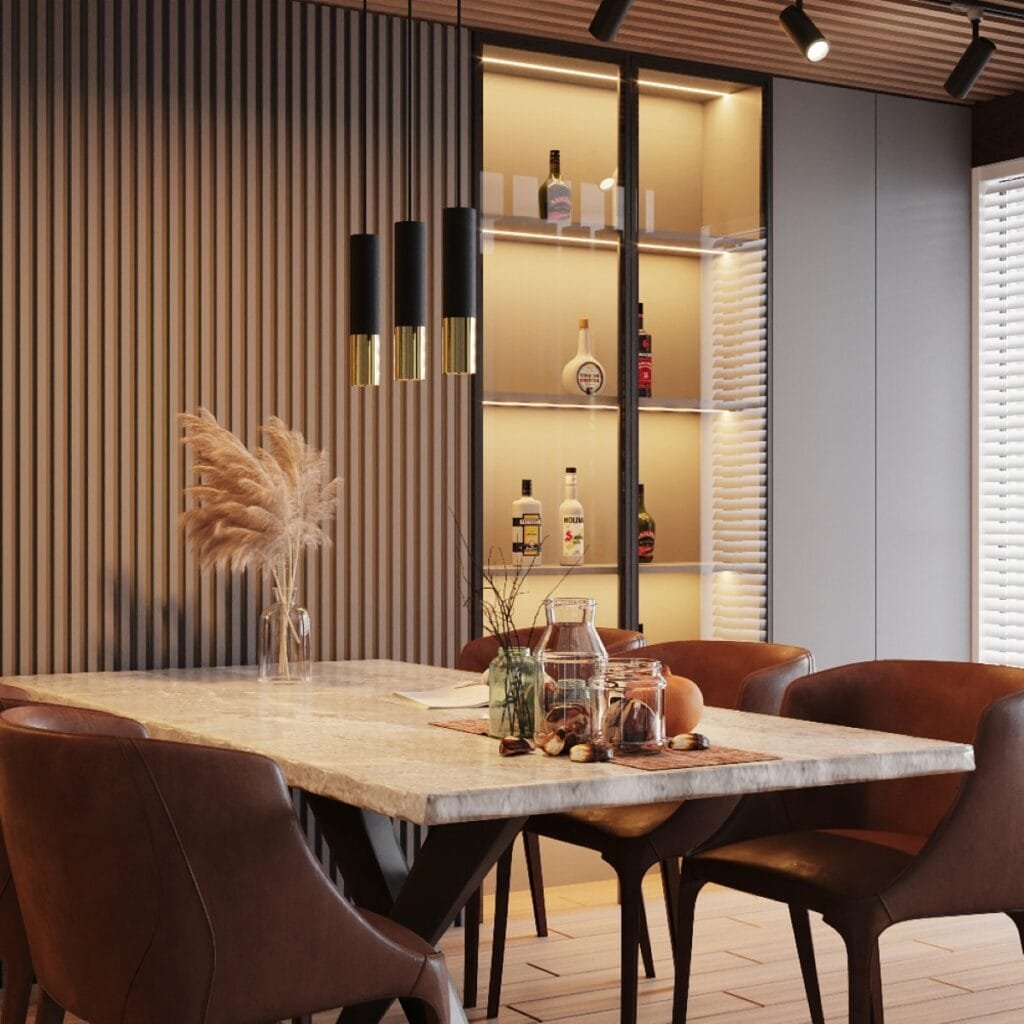
Gold, Copper & Chrome Lighting
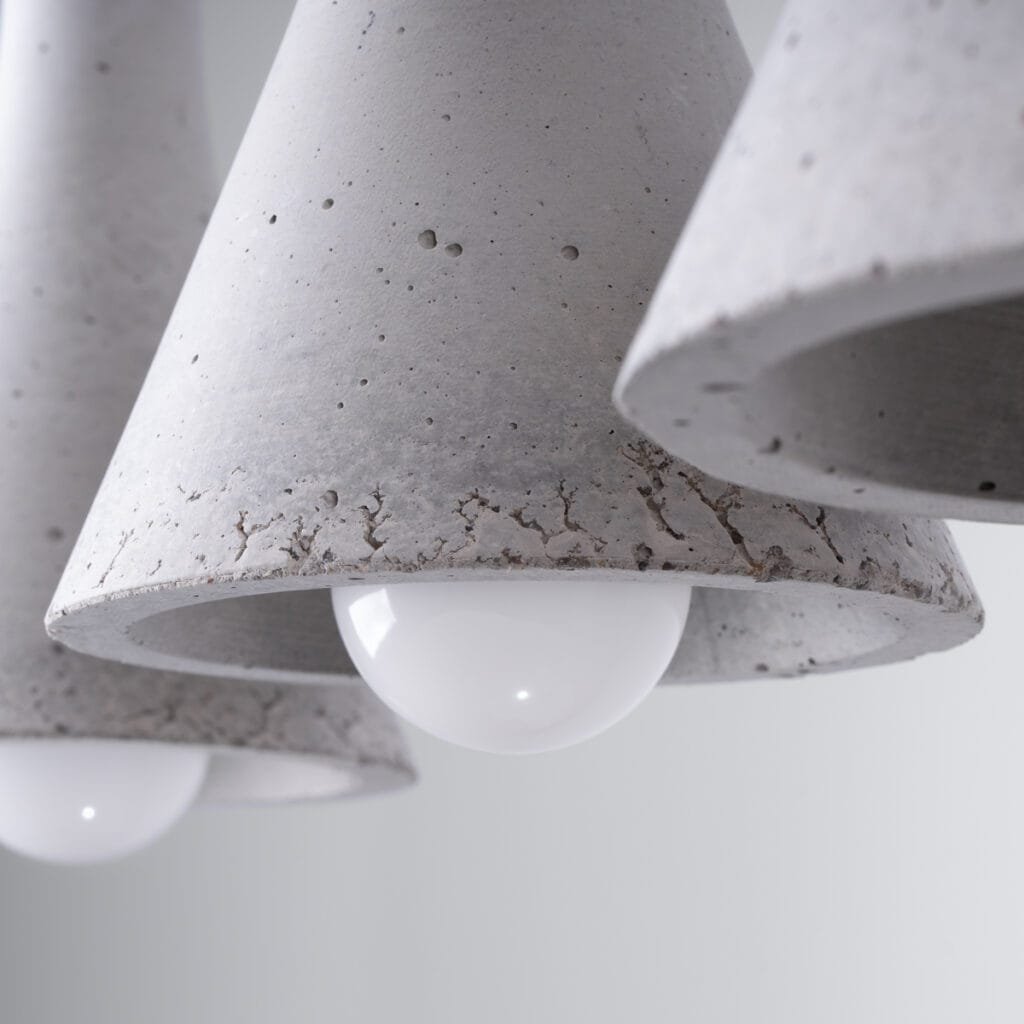
Concrete Lighting
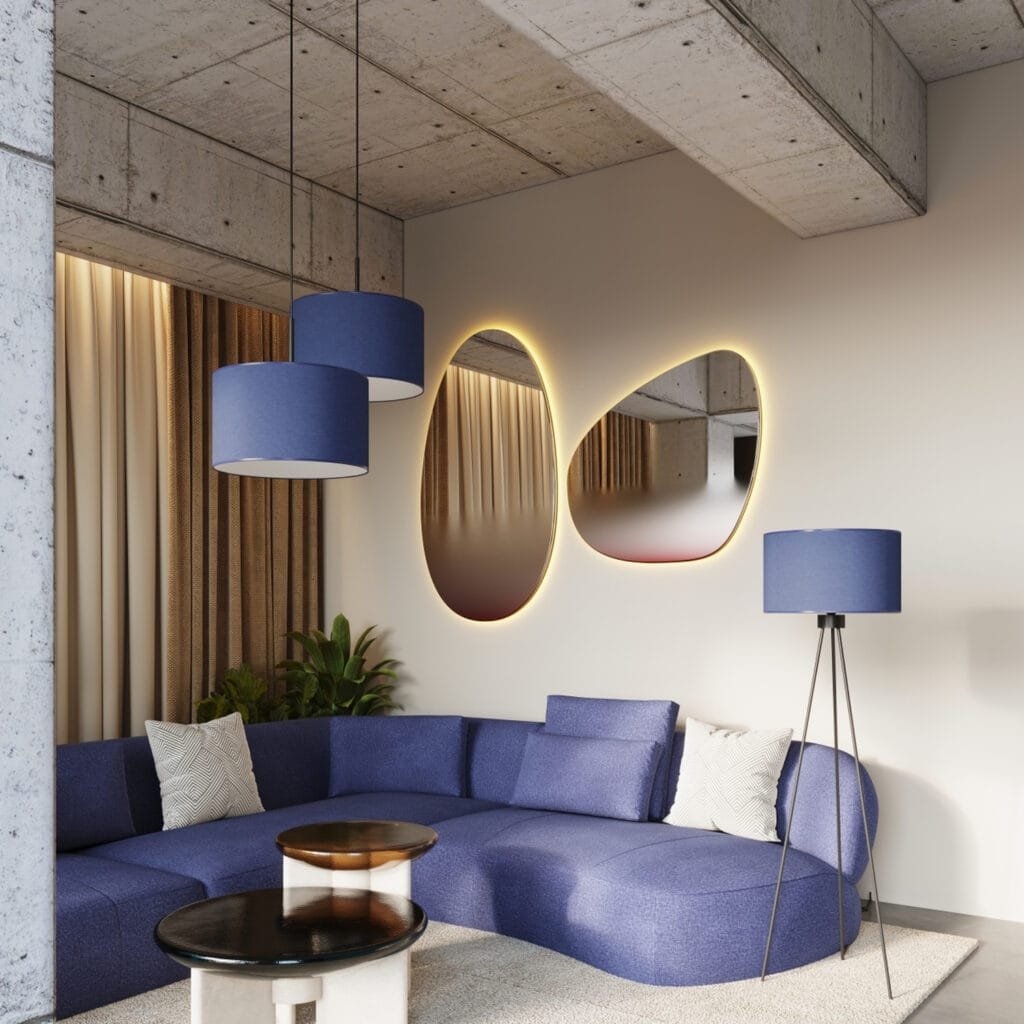
Table and Floor Lamps
The Six Essential Lighting Layers for 2026 Living Rooms
Modern living room lighting uses up to six distinct layers, each controllable independently.
Layer 1: Ambient (General) Ceiling Lighting
What it does: Provides overall illumination for the entire room.
2026 solutions:
Industrial ceiling lights: Multiple fixtures distributed across the ceiling, each with opal glass diffusers creating soft, glare-free ambient light. Matte black or neutral finishes that recede visually.
Recessed downlights: Arranged in a grid pattern for even coverage. Must be warm white (2700-3000K) with wide beam angles (40°+) to avoid spotty illumination.
Architectural flush-mounts: Low-profile fixtures that provide ambient light without visual clutter. Ideal for lower ceilings (under 2.5m).
Installation strategy:
- Rooms under 15 sq m: 3-4 ceiling fixtures
- Rooms 15-25 sq m: 4-6 ceiling fixtures
- Rooms over 25 sq m: 6+ ceiling fixtures
Critical: This layer should be dimmable and set on its own circuit (independent from other layers).
Common use:
- Bright (80-100%) for family activities, cleaning, children playing
- Medium (40-60%) for entertaining guests
- Low (20-30%) for background ambient glow during movie nights
- Off when using only accent and task lighting
Shop the look: Our Industrial Ceiling Lights collection offers ambient fixtures perfect for contemporary living rooms.
Layer 2: Statement Feature Lighting
What it does: Creates a focal point and adds design character.
2026 trends:
Large pendant over coffee table or seating area: A dramatic concrete, industrial, or barn-style pendant (50-70cm diameter) positioned over the main seating zone. This becomes the room’s visual anchor.
Sculptural floor lamp: A striking arc lamp or tripod floor lamp in brass or matte black that doubles as art and functional light.
Oversized wall light: An architectural wall sconce or large-scale industrial fixture that functions as both light source and design statement.
Why it matters: Feature lighting adds personality. This is where you express your design aesthetic and create memorable spaces.
Installation strategy:
- Choose ONE hero fixture (not multiple competing statement pieces)
- Position over the primary seating area or at a visual focal point
- Ensure it’s dimmable (essential for mood adjustment)
- Height for pendants over coffee tables: 180-200cm from floor to bottom of fixture
Common use:
- Medium-bright (60-80%) when this area is in active use
- Dimmed (20-40%) for ambient mood lighting
- Off when watching TV or using other zones
Shop the look: Industrial Pendants, Nautical Pendant Lights, and Concrete Lighting offer statement options perfect for living rooms.
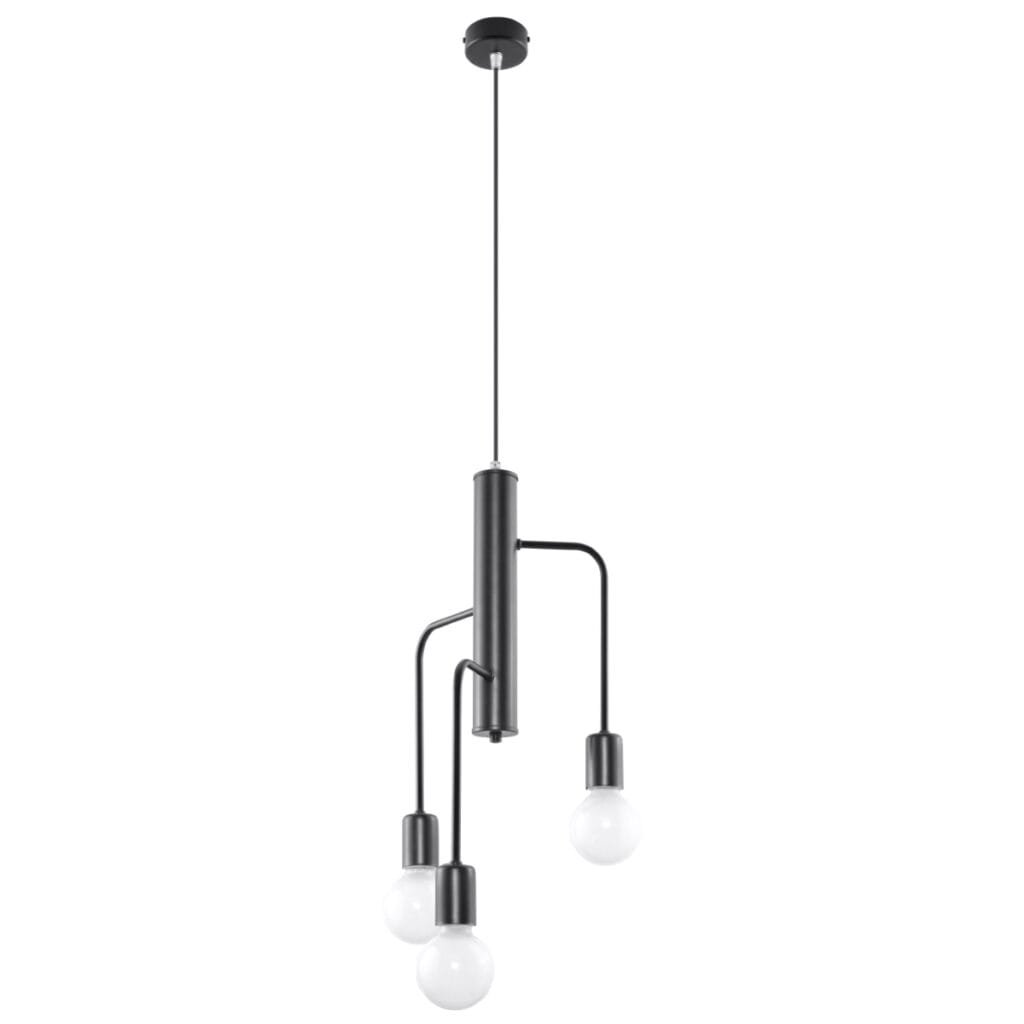
Multi Arm Ceiling Light Duomo Three Light Linear Black
The Duomo three-light linear in black is a bare-bulb industrial ceiling fitting — three exposed E27 bulbs on straight black steel arms arranged in a line, with no shades and no decorative elements beyond the raw geometry of the arms themselves. The fitting is honest about what it is: powder-coated steel, visible structure, and good light from exposed sources. In the right interior, that directness is precisely the point.
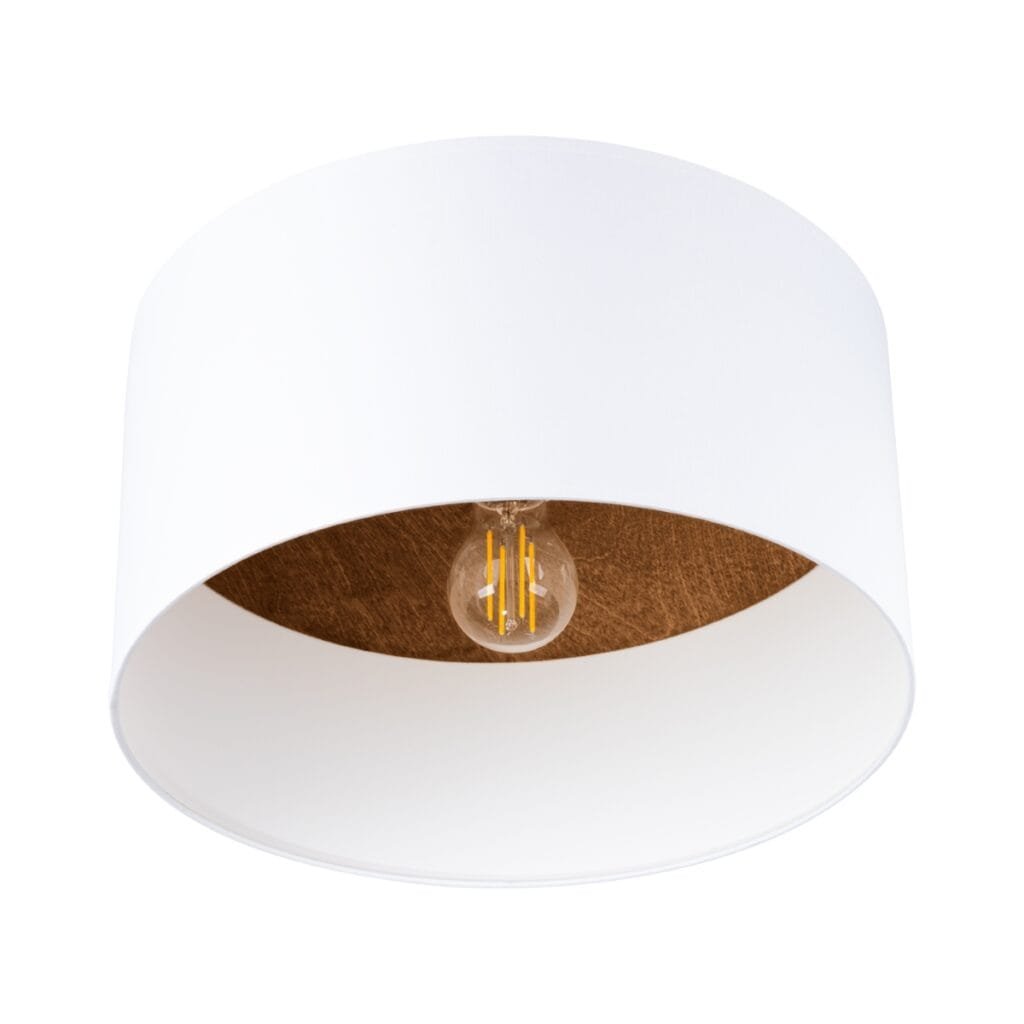
Telesto Ceiling Light – White / Dark Brown
The Telesto ceiling light in white and dark brown – a fabric shade on a wooden base that combines the softness of fabric diffusion with the warmth of natural wood. The white fabric shade diffuses E27 light evenly; the dark brown wood base grounds it visually and adds the material warmth that purely metal ceiling lights lack. Surface-mounted.
Available in other colour combinations.
Layer 3: Task Lighting for Specific Activities
What it does: Provides focused light for reading, working, hobbies, and detailed activities.
2026 solutions:
Adjustable floor lamps: Positioned beside reading chairs or sofas. Must have flexible heads or arms to direct light exactly where needed.
Architectural wall sconces: Mounted beside seating areas at reading height. Swing-arm or adjustable designs offer maximum flexibility.
Table lamps on side tables: Traditional solution that still works. Choose lamps with substantial shades that direct light downward for reading.
Installation strategy:
- Position task lights where people actually sit and read/work
- Reading light should come from over your shoulder, not in front of face
- Height: Floor lamp heads should be 100-120cm from floor when adjusted for reading
- Wall sconces: 110-130cm from floor to center of fixture when mounted beside seating
Critical specs:
- Warm white (2700-3000K) to prevent eye strain
- Dimmable for comfort adjustment
- Adjustable direction (swing-arm, articulated head, or flexible neck)
Common use:
- Bright (70-100%) for reading, working, hobbies
- Medium (40-60%) for ambient contribution to the zone
- Off when that seating area isn’t in use
Shop the look: Industrial Wall Lights includes reading-appropriate wall sconces with adjustable features.
Layer 4: Accent/Architectural Lighting
What it does: Highlights architectural features, creates depth, and adds visual interest.
2026 trends:
Wall washers: Linear LED strips or architectural sconces that create vertical washes of light on feature walls, bookcases, or artwork.
Picture lights: Small LED spots or linear fixtures illuminating specific artworks or wall displays.
Bookcase/shelf lighting: LED strips integrated into shelving units, creating warm glows around displayed objects.
Uplighting: Floor-mounted uplighters that wash light up textured walls or into room corners.
Cove lighting: LED strips hidden in architectural recesses, creating indirect ambient glow.
Why it matters: Accent lighting adds depth and dimension. Rooms feel larger and more sophisticated when vertical surfaces and architectural features are illuminated.
Installation strategy:
- Choose 2-3 accent lighting elements (not everything—selective highlighting is more effective)
- Use very warm white (2200-2700K) for cozy atmospheric glow
- Ensure everything is dimmable or controllable independently
- LED strips should be concealed—you see the glow, not the strip itself
Common use:
- Medium (40-60%) when entertaining or wanting dramatic atmosphere
- Low (15-30%) for ambient mood lighting
- Off during daytime or when bright general lighting is needed
Layer 5: Decorative Lighting
What it does: Adds character and personal style through lighting that’s as much about aesthetics as function.
2026 trends:
Decorative wall sconces: Brass-accented, concrete, or industrial sconces mounted on walls for visual interest and supplementary lighting.
Cluster pendants: Groups of small pendants at varying heights creating sculptural installations.
Feature table lamps: Designer lamps with distinctive shapes, materials, or finishes that function as decorative objects.
Candle-style fixtures: Wall-mounted or tabletop fixtures that mimic candlelight (very warm 2200K LEDs).
Why it matters: Decorative lighting expresses your personality and prevents living rooms from feeling too utilitarian.
Installation strategy:
- Select 1-3 decorative fixtures that complement (not compete with) your statement feature lighting
- Mix materials: if statement pendant is concrete, consider brass decorative sconces
- Position decoratively lit elements where eyes naturally rest (flanking fireplaces, framing windows, beside bookcases)
Common use:
- Medium (50-70%) when entertaining to showcase design elements
- Low (20-40%) for background ambiance
- Often left on as constant mood lighting even when other layers cycle on/off
Shop the look: Industrial Wall Lights and Modern Wall Lighting offer decorative fixtures that combine function with design character.
Layer 6: Natural Light Enhancement
What it does: Maximizes and complements natural daylight during the day.
2026 approach:
Window treatments: Sheer curtains that diffuse natural light during the day, with blackout layers for movie nights.
Reflective surfaces: Mirrors, brass fixtures, and metallic accents positioned to bounce natural light deeper into the room.
Daytime dimming: Use dimmers to reduce artificial lighting when natural light is strong, creating seamless day-to-night transitions.
Strategic fixture positioning: Place warm-white artificial lights where they’ll complement (not compete with) natural light patterns.
Why it matters: Rooms that integrate natural and artificial light feel more connected to the outdoors and use energy more efficiently.
The Core Principle: Layered, Independent, Dimmable
Before diving into specific trends and fixtures, understand the fundamental philosophy of 2026 living room lighting:
Multiple Independent Layers
Not this: One ceiling light + two table lamps (3 fixtures, limited flexibility)
This: Ceiling ambient layer + statement pendant + wall sconces + floor lamps + accent lighting (6-8 fixtures, infinite combinations)
Why it matters: With multiple independent layers, you can create dozens of different moods and configurations from the same fixture set.
Everything on Dimmers
Every circuit should dim from 100% down to 10% or lower. This isn’t optional—it’s foundational to 2026 living room design.
Why it matters:
- Bright light for family activities and cleaning
- Medium light for entertaining and dining
- Low light for movie watching and relaxed evenings
- Very low light for ambient background glow
Without dimmers, you’re locked into fixed brightness levels that won’t suit different activities.
Warm White Throughout
Living rooms should use warm white LEDs exclusively: 2700-3000K.
Not 4000K+ (that’s for task-heavy spaces like kitchens and offices)
Not cool white (creates uncomfortable, unwelcoming atmosphere)
The warmest tones (2200-2700K) create the most inviting, relaxing spaces. This is especially important for evening use when cooler light can feel harsh.
Statement Lighting: Choosing Your Hero Fixture
Every 2026 living room needs one standout lighting piece. Here’s how to choose and position it.
Pendant Lights Over Coffee Tables
The trend: Large pendants (50-70cm diameter) hung over coffee tables as the room’s focal point.
Size guidelines:
- Coffee table 90-120cm long: Pendant 50-55cm diameter
- Coffee table 120-150cm long: Pendant 55-65cm diameter
- Coffee table 150cm+ long: Pendant 65-75cm diameter OR consider elongated linear pendant
Hanging height: 180-200cm from floor to bottom of pendant. Must clear heads when people stand but be low enough to anchor the seating zone.
Style options:
Concrete dome pendant: Industrial-minimalist aesthetic. Earthy, grounding, pairs with natural materials. Often features brass detailing or warm brass interior to reflect light beautifully.
Large barn pendant: Modern farmhouse feel. Matte black exterior with gold/brass interior. Creates warm, directional light perfect for seating areas.
Industrial cage pendant: Raw, honest design. Metal cage framework with large Edison-style LED bulb. More casual and relaxed than concrete.
Oversized globe pendant: Sculptural, architectural. Black metal frame with opal glass diffuser. Soft, even light distribution.
Shop the look: Industrial Pendants, Large Pendant Lights, and Concrete Lighting all offer statement-making living room options.
Arc Floor Lamps
The trend: Dramatic arcing floor lamps that curve over seating areas, providing overhead task/ambient lighting without ceiling installation.
Why they work:
- No electrical work required (plug-in)
- Flexible positioning—can be moved to different seating zones
- Creates architectural impact
- Provides overhead-style light without ceiling fixtures
2026 styles:
- Brass or black arc with concrete or marble base
- Minimalist steel arc with adjustable head
- Multi-arm designs with several adjustable light heads
Positioning: Base beside sofa or chair, with light head positioned 40-60cm out from seating edge, approximately 180-200cm high.
Critical: Must be dimmable (use smart plugs or lamps with built-in dimmers).
Wall-Mounted Statement Pieces
The trend: Oversized architectural wall sconces that function as sculptural art and practical lighting.
When to use: When ceiling height is limited (under 2.5m) or when ceiling fixtures would interfere with existing architecture (beams, skylights, etc.).
2026 styles:
- Large concrete wall sconces with geometric forms
- Brass-accented industrial sconces (30-40cm tall)
- Linear wall washers that create dramatic uplighting
Positioning: On prominent walls—flanking fireplaces, on either side of large windows, on feature walls opposite seating.
Shop the look: Industrial Wall Lights and Concrete Lighting include statement-scale wall fixtures.
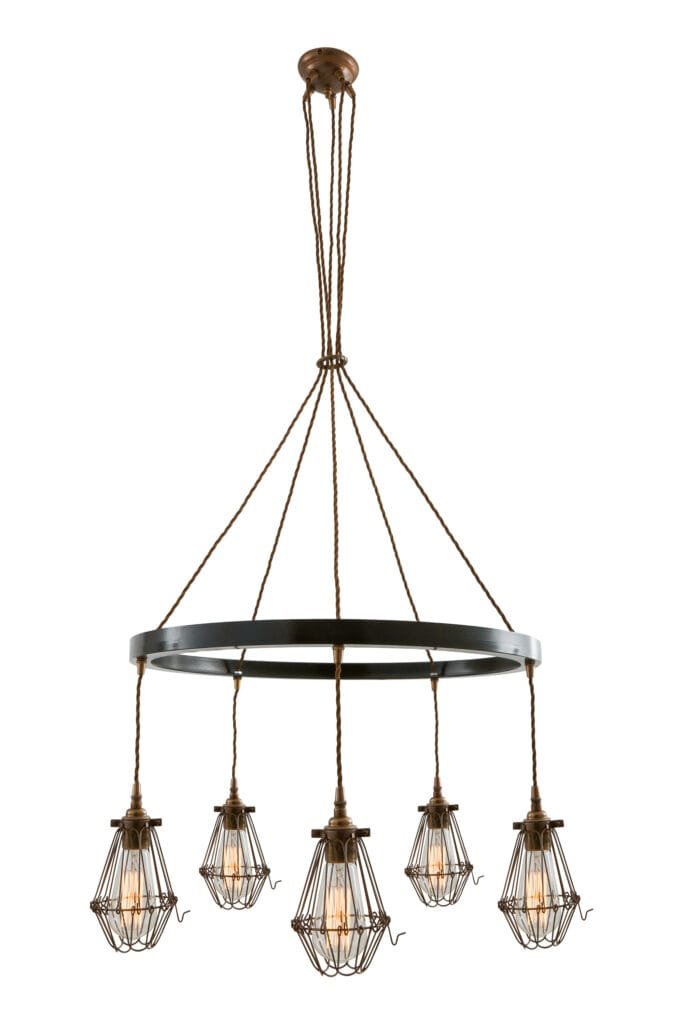
Praia Industrial Cage 5 Light Ring Chandelier
Elevate Your Interiors with the Praia Industrial Cage Chandelier
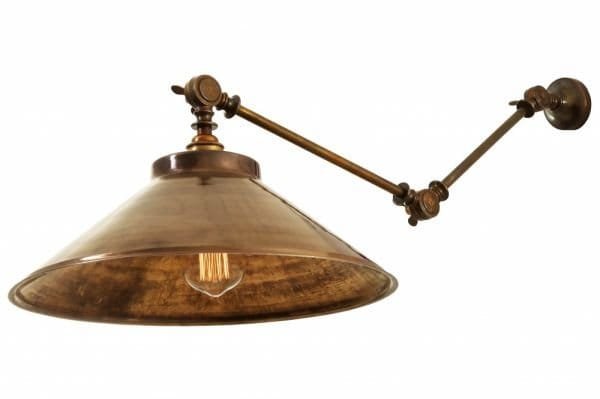
Rio Adjustable Industrial Wall Light
Living Room Lighting by Room Size & Layout
Different living room configurations need different layered approaches.
Small Living Rooms (Under 15 sq m)
Challenge: Limited space means fewer fixtures; risk of feeling cramped if over-lit.
2026 solution:
- Ambient: 2-3 ceiling fixtures (industrial style with opal glass) OR 4-5 recessed downlights
- Statement: ONE feature—either medium pendant over coffee table OR striking arc floor lamp
- Task: 1-2 adjustable floor lamps or wall sconces beside seating
- Accent: Minimal—perhaps one LED strip under floating media console
- Decorative: One pair of decorative wall sconces maximum
Total fixtures: 5-8 (keep it simple to avoid visual clutter)
Key principle: Less is more. Choose multi-functional fixtures and focus on quality over quantity.
Medium Living Rooms (15-25 sq m)
Challenge: Balancing adequate lighting with creating distinct zones within one space.
2026 solution:
- Ambient: 4-5 ceiling fixtures distributed evenly OR 6-8 recessed downlights
- Statement: One large pendant (55-65cm) over main coffee table
- Task: 2-3 task lights (floor lamps beside reading chairs, wall sconces by sofa)
- Accent: 2-3 elements (wall washers, bookcase lighting, picture lights)
- Decorative: 1-2 pairs of decorative sconces or 2-3 decorative table lamps
Total fixtures: 10-15
This is the “standard” living room where you can implement full layering without overcrowding.
Key principle: Create functional zones (seating zone, reading zone, media zone) with independent lighting control for each.
Large Living Rooms (Over 25 sq m)
Challenge: Providing adequate lighting across large space while avoiding airport-terminal feel.
2026 solution:
- Ambient: 6-8+ ceiling fixtures OR 10+ recessed downlights on multiple circuits (allows dimming sections independently)
- Statement: 1-2 hero fixtures (large pendant over main seating + arc lamp over secondary seating)
- Task: 3-5 task lights serving different seating zones
- Accent: 4-6 accent elements creating depth and dimension throughout
- Decorative: Multiple decorative fixtures adding character to different zones
Total fixtures: 15-25+
Key principle: Divide large rooms into 2-3 distinct lighting zones (conversation zone, reading zone, entertainment zone). Each zone should be independently controllable.
Open-Plan Living/Dining/Kitchen
Challenge: Creating defined zones while maintaining visual cohesion across open space.
2026 solution:
Living zone:
- Pendant or arc lamp defining seating area
- Task lighting for reading/working
- Accent lighting on living room walls
Dining zone:
- Statement pendant over dining table (separate from living pendant)
- Optional: wall sconces on adjacent walls
Kitchen zone:
- See our Kitchen Lighting Trends 2026 guide for complete kitchen lighting
Ambient lighting:
- Continuous ceiling fixture grid across entire open space
- All on dimmers so each zone can be adjusted independently
- Maintains visual continuity while allowing functional zoning
Key principle: Use lighting to define zones without harsh divisions. Consistent colour temperature (2700-3000K) throughout maintains cohesion.
Critical: Each zone needs independent dimmer control. Open-plan living requires at least 3-4 separate dimmer circuits.
Material & Finish Trends for 2026 Living Rooms
Concrete: The Grounding Element
Concrete remains a hero material for 2026 living room lighting, bringing organic texture and industrial sophistication.
What’s trending:
- Large concrete dome pendants (50-70cm) as statement fixtures
- Concrete combined with brass detailing (brass sockets, hanging rods, interior accents)
- Light grey or taupe concrete (not dark charcoal)
- Polished or sealed finishes (not rough unfinished)
Why it works: Concrete adds weight and substance to airy contemporary spaces. The natural material aesthetic pairs beautifully with wood furniture, natural textiles, and plants.
Where to use:
- Statement pendants over coffee tables
- Large wall sconces on feature walls
- Table lamp bases (concrete + linen shade combinations)
Pairs with: Natural oak or walnut furniture, linen upholstery, warm neutral colour palettes, brass accents.
Shop the look: Industrial Wall Lighting features living room-appropriate fixtures that ground contemporary spaces.
Matte Black: The Contemporary Classic
Powder-coated matte black metal provides visual anchor points without visual heaviness.
What’s trending:
- Black fixtures with warm brass or gold interiors (exterior black, interior warm metallic)
- Black metal cages with opal glass diffusers
- Black combined with concrete or wood elements
- Mixed finishes (black frame + brass details)
Why it works: Black creates definition in all-neutral or all-white spaces. Modern powder coatings are durable and maintain their finish for decades.
Where to use:
- All lighting layers (ambient ceiling lights, statement pendants, task lighting, accent fixtures)
- Particularly effective for industrial ceiling lights that should visually recede
Pairs with: Any colour palette. Especially strong with whites, greys, woods, and plants.
Shop the look: Modern Ceiling Lights, Industrial Pendants, and Industrial Wall Lights all feature matte black options.
Warm Brass & Soft Gold
Cool metals (chrome, brushed nickel) are out. Warm metallics are defining 2026.
What’s trending:
- Brushed brass (not shiny polished brass)
- Antique brass with slight patina
- Soft gold finishes
- Aged copper accents
Why it works: Warm metals complement warm white LEDs, creating cohesive, inviting spaces. They add richness without traditional formality.
Where to use:
- Accent details (not usually entire fixtures)
- Arc floor lamps and tripod floor lamps
- Decorative wall sconces
- Interior surfaces of black/concrete fixtures (brass inside creates warm reflected light)
Pairs with: Rich jewel tones (emerald, navy, burgundy), natural woods, velvet upholstery.
Critical: Use brass as accent, not dominant material. The trend is subtle brass details, not all-brass rooms.
Natural Materials & Textures
What’s trending:
- Wood elements in lighting (walnut or oak bases, wood-bead pendants)
- Natural linen and fabric shades
- Rattan and woven materials (typically on table/floor lamps rather than ceiling fixtures)
- Stone bases (marble, slate)
Why it works: Natural materials connect interiors to nature (biophilic design) and create psychological warmth.
Where to use:
- Table lamp bases and shades
- Floor lamp stands and shades
- Decorative accent lighting
Pairs with: Neutral palettes, natural fiber rugs, houseplants, organic textures.
Opal & Diffused Glass
Exposed Edison bulbs are fading. Diffused glass is in.
What’s trending:
- White opal glass domes and globes
- Frosted glass cylinders
- Ribbed or fluted glass adding texture
- Glass combined with metal cages (industrial aesthetic)
Why it works: Diffused glass eliminates glare while creating soft, atmospheric light. More sophisticated and comfortable than exposed bulbs.
Where to use:
- Ceiling ambient fixtures (opal glass diffusers essential for glare-free light)
- Statement pendants (opal globe inside metal cage)
- Wall sconces
Colour Temperature & Dimming Strategy
The 2700-3000K Rule
Living rooms should use warm white exclusively:
2700K: Very warm, like traditional incandescent bulbs. Best for evening ambient and mood lighting. Creates the most relaxing, intimate atmosphere.
3000K: Warm white, slightly brighter and crisper than 2700K. Good for task lighting (reading lamps) while still maintaining warmth.
Never use 4000K+ in living rooms. Cool white creates uncomfortable, unwelcoming spaces that feel institutional rather than residential.
Dimming for Different Activities
Living rooms serve multiple purposes. Here’s how to use dimming to support each:
Family Activities (Playing, Crafts, Homework):
- Ambient ceiling: 80-100%
- Task lighting where needed: 80-100%
- Statement/decorative: 30-50%
- Accent: Off
Entertaining Guests:
- Ambient ceiling: 40-60%
- Statement feature: 60-80%
- Decorative fixtures: 60-80%
- Accent: 40-60%
- Task: As needed per seating zone
Relaxed Evening / Reading:
- Ambient ceiling: 20-40%
- Statement feature: 30-50%
- Task lighting where reading: 70-90%
- Decorative: 30-50%
- Accent: 30-50%
Movie Night / TV Watching:
- Ambient ceiling: Off or 10-20% maximum
- Statement feature: Off
- Task: Off
- Accent: 20-30% (very low atmospheric glow)
- Decorative: Off or 10-20%
Romantic Evening / Intimate Dinner:
- Ambient ceiling: Off or 10%
- Statement feature: 20-30%
- Decorative: 40-60%
- Accent: 30-50%
- Task: Off
The key: With fully layered, independently dimmable lighting, you can create all these scenarios from the same fixture set.
Smart Lighting Integration for Living Rooms
Smart lighting makes complex layered systems practical and user-friendly.
Smart Dimmer Switches
What they are: Replace standard wall switches with smart dimmers that control conventional dimmable bulbs.
Why they’re ideal for living rooms:
- Control multiple fixtures from single switch
- Create programmable scenes (“Movie Night,” “Entertaining,” “Reading”)
- Voice control (“Alexa, set living room to 30%”)
- Integration with home automation systems
Best brands for UK:
- Lutron Caséta (premium, rock-solid reliability)
- Philips Hue dimmers (integrate with Hue ecosystem)
- TP-Link Kasa (good value, no hub required)
Installation: Requires electrician (replacing wall switches involves electrical work).
Smart Bulbs
What they are: LED bulbs with built-in wireless connectivity.
When to use in living rooms:
- Table lamps and floor lamps (easy retrofit without electrical work)
- Accent lighting you want individual control over
- Fixtures you want to change colour temperature (though living rooms should stay warm white)
Limitations:
- More expensive than conventional bulbs
- Require fixture switch to remain “on” (confusing for guests)
- Each bulb needs individual setup
Best brands:
- Philips Hue (most mature ecosystem, excellent app)
- IKEA TRÅDFRI (budget-friendly, good basics)
- TP-Link Kasa/Tapo (good value, no hub needed)
Lighting Scenes for Living Rooms
Program these scenes for instant ambiance:
“Good Morning”
- All ceiling lights: 70%
- Task lights: Off
- Decorative: 50%
- Accent: Off
“Entertaining”
- Ceiling: 50%
- Statement feature: 70%
- Decorative: 70%
- Accent: 50%
- Task: As needed
“Movie Time”
- Ceiling: Off
- Statement: Off
- Accent: 20% (very low glow)
- Task: Off
- Decorative: 10%
“Reading”
- Ceiling: 30%
- Statement: 40%
- Specific task light: 80%
- Decorative: 30%
- Accent: 30%
“Bedtime”
- All fixtures: 10% or off
- Optional: One accent fixture at 15% as nightlight
“Away Mode”
- Random cycling through different scenes
- Simulates occupancy when you’re on holiday
Voice Control Integration
Popular commands:
- “Set living room to entertaining”
- “Dim living room lights to 30%”
- “Turn on reading lamp”
- “Living room movie mode”
Compatible assistants:
- Amazon Alexa
- Google Assistant
- Apple HomeKit / Siri
Installation Planning & Electrical Work
Professional vs. DIY
Hire an electrician for:
- Installing ceiling fixtures (pendants, flush-mounts, recessed downlights)
- Hardwiring wall sconces
- Adding new circuits or dimmer switches
- Any work involving your consumer unit
DIY appropriate:
- Positioning floor lamps and table lamps
- Installing plug-in wall sconces (if outlet available)
- Adding LED strip accent lighting (adhesive-backed, plug-in types)
- Replacing existing plug-in lamps
UK regulations: Most living room electrical work isn’t notifiable under Part P Building Regulations, but poor electrical work is dangerous. If unsure, hire a professional.
Planning New Circuits
If renovating or adding substantial lighting, consider adding circuits:
Minimum for basic living room: 2 circuits
- Circuit 1: Ambient ceiling lighting
- Circuit 2: Wall outlets (for lamps)
Better: 3-4 circuits
- Circuit 1: Ambient ceiling lighting
- Circuit 2: Statement/feature fixtures
- Circuit 3: Wall sconces / hardwired task lights
- Circuit 4: Outlets for lamps
Ideal for large/open living rooms: 5-6 circuits
- Multiple ambient circuits allowing zonal control
- Separate circuits for different functional zones
- Accent lighting on dedicated circuit
Each circuit needs its own dimmer switch for full control flexibility.
Dimmer Switch Considerations
Choose LED-compatible dimmers:
- Old incandescent dimmers don’t work properly with LEDs
- LED dimmers must be rated for low wattage (LEDs draw 10-15W vs 60-100W for incandescent)
- Quality matters—cheap dimmers cause flickering and buzzing
Recommended:
- Lutron (premium, smooth dimming, no flicker)
- Varilight (UK brand, reliable)
- LAP (Screwfix own-brand, good value)
Test compatibility: If possible, test your chosen dimmer with your chosen bulbs before installing throughout. Some LED bulbs dim better than others.
Cable Management for Table/Floor Lamps
Living rooms can accumulate messy lamp cables. Solutions:
Cable tidies and clips: Route cables along furniture legs and baseboards.
Furniture with cable management: Media consoles and side tables with built-in cable routing.
Floor outlets: Consider installing floor-mounted outlets in center of room if planning furniture arrangement away from walls.
Battery-powered accent lights: For accent lighting (under shelves, behind TV), battery-powered LED strips eliminate cables entirely.
Budget Planning for Living Room Lighting
Where to Invest
Priority 1: Dimmer switches. Quality dimmers (£40-70 each) transform lighting flexibility. This is where money is best spent.
Priority 2: Statement fixture. Your hero pendant or floor lamp should be quality. Budget £200-500 for a statement piece that’ll last 20+ years.
Priority 3: Task lighting. Floor lamps beside reading chairs get daily use. Invest £100-200 each in adjustable, quality lamps.
Where to Save
Ambient ceiling fixtures: These recede into background. Mid-range fixtures (£50-100 each) work perfectly well.
Accent lighting: LED strips and simple picture lights. Quality warm white strips cost £20-60 and do the job.
Decorative table lamps: Affordable options (£40-80) can look expensive if chosen well. Focus on shade quality and proportions.
Sample Budgets
Budget living room lighting (£600-1,000):
- 4x Industrial ceiling lights: £60-80 each = £240-320
- 1x Statement pendant OR floor lamp: £150-250
- 2x Floor task lamps: £60-100 each = £120-200
- 2x Table lamps: £40-60 each = £80-120
- LED accent strips: £30-50
- 3x Quality dimmer switches: £40-60 each = £120-180
- Installation (if needed): £200-400
Mid-range living room (£1,200-2,000):
- 5x Industrial ceiling lights: £80-120 each = £400-600
- 1x Premium statement pendant: £300-500
- 2-3x Quality floor lamps: £100-150 each = £200-450
- 2-3x Designer table lamps: £80-120 each = £160-360
- Accent lighting system: £80-150
- 4x Premium dimmer switches: £60-80 each = £240-320
- 2x Decorative wall sconces: £100-150 each = £200-300
- Professional installation: £300-600
Luxury living room (£2,500-4,500):
- 6-8x Premium ceiling fixtures: £120-200 each = £720-1,600
- 1-2x Designer statement pieces: £500-900 each = £500-1,800
- 3-4x Premium task lights: £150-250 each = £450-1,000
- 3-4x Designer decorative lamps: £120-200 each = £360-800
- Complete accent lighting system: £200-400
- Smart lighting system (hub + switches): £400-700
- Professional installation & programming: £600-1,200
Living Room Lighting by Design Style
Contemporary Minimalist
Lighting palette:
- Recessed downlights providing invisible ambient light
- One large concrete or black pendant as minimal statement
- Slimline architectural wall sconces
- Hidden LED strips (you see the glow, never the strip)
Effect: Clean, uncluttered, gallery-like sophistication.
Avoid: Decorative excess, ornate fixtures, visible bulbs.
Shop the look: Concrete Lighting + Industrial Ceiling Lights
Industrial Modern
Lighting palette:
- Multiple matte black industrial ceiling lights
- Concrete dome pendant over seating
- Black metal cage fixtures
- Edison-style warm LED bulbs (2700K)
- Exposed cables as design feature
Effect: Raw materials refined with contemporary comfort.
Avoid: Overly polished finishes, traditional shades.
Shop the look: Industrial Pendants + Concrete Lighting + Industrial Wall Lights
Warm Modern Farmhouse
Lighting palette:
- Nautical-style pendant over coffee table
- Black fixtures with brass interiors
- Natural linen and fabric shades on lamps
- Warm white (2700K) throughout
- Mix of metal and natural materials
Effect: Inviting, characterful, cozy-meets-contemporary.
Avoid: Overly rustic or distressed finishes (the trend is refined farmhouse, not shabby chic).
Shop the look: Nautical Pendant Lights + Modern Minimalist Ceiling Lights
Scandinavian Minimalism
Lighting palette:
- Simple white or light grey fixtures
- Natural wood lamp bases and stands
- Opal glass globes and spheres
- Soft, diffused light throughout
- Very warm white (2700K)
Effect: Light, airy, calm, uncluttered.
Avoid: Dark or heavy fixtures, ornate details.
Mid-Century Modern
Lighting palette:
- Brass or copper arc floor lamps
- Geometric pendant shapes
- Tripod floor lamps with conical shades
- Warm metallic finishes throughout
- Table lamps with sculptural bases
Effect: Retro-cool with timeless sophistication.
Avoid: Industrial or overly contemporary aesthetics.
Common Living Room Lighting Mistakes
Mistake 1: Only Overhead Lighting
The problem: One ceiling light (even a nice pendant) can’t serve all living room needs.
The fix: Layer: ceiling + statement + task + accent. Minimum 4-5 independent lighting sources.
Mistake 2: Everything on One Switch
The problem: All lights tied to single switch = no flexibility.
The fix: Multiple circuits with separate dimmers. Allows infinite combinations and moods.
Mistake 3: No Task Lighting
The problem: Can’t comfortably read or work in specific seating zones.
The fix: Adjustable floor lamps or wall sconces beside every seating area used for reading/tasks.
Mistake 4: Too Bright Overall
The problem: Living rooms lit like offices—harsh, unwelcoming, no atmosphere.
The fix: Use warm white (2700-3000K) only + dimmers on everything + layer lights at different levels instead of flooding from ceiling.
Mistake 5: Ignoring Vertical Surfaces
The problem: All light aimed downward; walls and vertical space remain dark.
The fix: Add accent lighting (wall washers, uplighters, sconces) to illuminate vertical surfaces and create depth.
Mistake 6: Wrong Bulb Colour Temperature
The problem: Cool white (4000K+) or mismatched temperatures creating uncomfortable, disjointed feeling.
The fix: Warm white (2700-3000K) throughout, with all fixtures using same colour temperature for cohesion.
Mistake 7: Pendant Too High or Too Low
The problem: Pendant over coffee table positioned incorrectly (too high = no impact; too low = head-bumping).
The fix: 180-200cm from floor to bottom of pendant. Marks the seating zone without obstructing movement.
Mistake 8: Neglecting Dimmers
The problem: Fixed brightness unsuitable for multiple uses.
The fix: Every circuit dimmable. This single upgrade transforms living room versatility.
Maintenance & Longevity
LED Lifespan
Quality LED bulbs last 25,000-50,000 hours. In living rooms (averaging 5 hours/day use):
- 25,000-hour LED: 13+ years
- 50,000-hour LED: 27+ years
Future-proofing: Choose fixtures with replaceable bulbs (E27/E14/GU10 fittings) rather than integrated LEDs. When bulbs eventually fail, replacement is simple and inexpensive.
Fixture Care
Concrete: Dust with dry microfiber cloth monthly. Spot-clean with barely damp cloth only if necessary.
Matte black metal: Microfiber cloth only. Avoid liquids that can damage powder coating.
Brass: Buff gently with soft cloth. Natural patina development is desirable in 2026 aesthetic.
Fabric/linen shades: Vacuum with upholstery attachment quarterly. Some can be spot-cleaned.
Opal glass: Remove and wash in warm soapy water annually for maximum light output.
When to Update
Quality living room lighting should last 15-25+ years with LED technology. Update when:
- Your aesthetic preferences change substantially
- Fixtures become damaged
- You undertake major renovation
- Technology advances offer genuinely better functionality
Avoid: Chasing trends too closely. Choose timeless fixtures you’ll love for decades.
What’s Next? Complete Your 2026 Home
You’ve now explored comprehensive lighting guides for every major room:
- Modern Lighting Trends for 2026 – The complete overview across your entire home
- Kitchen Lighting Trends 2026 – Layered task and statement lighting for functional kitchens
- Bedroom Lighting Trends 2026 – Wellness-focused lighting supporting better sleep
- Bathroom Lighting Trends 2026 – LED mirrors and IP-rated fixtures combining safety with style
- Living Room Lighting Trends 2026 – You’re here!
Additional rooms: For hallways, dining rooms, home offices, and outdoor spaces, the same core principles apply: layer your lighting, use warm white LEDs, put everything on dimmers, and combine statement pieces with functional fixtures.
Transform Your Living Room with Layered Lighting
Browse our curated collections for creating versatile, beautifully lit living spaces:
- Industrial Pendants – Statement fixtures that define living room character
- Concrete Lighting – Natural material fixtures bringing grounding sophistication
- Industrial Ceiling Lights – Ambient fixtures creating comfortable background illumination
- Farmhouse Pendant Lights – Warm, characterful statements for farmhouse-modern spaces
- Industrial Wall Lights – Task, accent, and decorative fixtures for layered lighting
Have questions about creating your layered lighting scheme or choosing fixtures for your specific space? Our team is here to help. Explore our collections or get in touch to start creating your 2026-inspired living room.