Kitchen Island Lighting Guide: Complete UK Planning & Design Resource
Your kitchen island deserves lighting that works as hard as you do. Beyond illuminating food preparation, island lighting defines your kitchen’s character, creates focal points, and transforms functional workspaces into social hubs where family and friends naturally gather.
Yet achieving perfect island lighting requires careful planning. Hang fixtures too low and you’ll create head-bump hazards. Space them incorrectly and you’ll have pools of light and shadow. Choose the wrong style and your expensive kitchen renovation looks unfinished.
At Great Lighting, we specialise in kitchen island lighting from quality European manufacturers—Mullan Lighting (Ireland) and Sollux (Poland). Rather than mass-produced imports designed for short lifespans, our collection focuses on fixtures built to last decades: solid brass developing character over time, hand-glazed ceramics with unique finishes, and quality construction justifying the investment.
This comprehensive guide answers every question about kitchen island lighting, from fundamental planning (how many fixtures, what height, which style) through to specific product recommendations for different island configurations.
- Why Kitchen Island Lighting Matters
- The Essential Questions: How Many Lights and What Height?
- Choosing the Right Pendant Size for Your Island
- Bold Industrial Style
- Mid Century Brass
- Kitchen Island Lighting Styles
- Wood Trimmed Lighting
- Modern Concrete
- Technical Specifications: Getting the Details Right
- Installation and Electrical Planning
- Conclusion: Creating Your Perfect Island Lighting
Why Kitchen Island Lighting Matters
Kitchen islands have evolved from simple prep surfaces into multifunctional spaces accommodating food preparation, casual dining, homework sessions, and social gathering. Lighting these versatile surfaces requires fixtures that:
Provide adequate task lighting: Bright, shadow-free illumination for food preparation, ensuring safety when handling knives and hot pans.
Create ambiance: Adjustable lighting that transitions from bright work mode to dimmed dining atmosphere.
Make design statements: Island lighting sits at eye level, becoming a focal point visible from multiple angles. These fixtures define your kitchen’s style more than any other lighting choice.
Define zones: In open-plan spaces, island lighting visually separates kitchen work areas from adjacent living spaces.
Poor island lighting wastes your kitchen investment. Conversely, well-planned fixtures enhance functionality, improve aesthetics, and add genuine value to your home.
The Essential Questions: How Many Lights and What Height?
How Many Pendant Lights Over Kitchen Island?
The most common island lighting question—and the answer depends on island length and fixture size.
General guidelines by island length:
1.2-1.5 metre islands: Single large pendant (35-45cm diameter) or two small pendants (20-28cm diameter)
1.8-2.1 metre islands: Two medium pendants (28-35cm diameter) or three small pendants (20-28cm)
2.4-2.7 metre islands: Three medium pendants (28-35cm) or four small pendants (20-28cm)
3+ metre islands: Four medium pendants or five small pendants, OR consider linear suspension fixtures
Spacing between fixtures: Maintain 60-75cm spacing between pendant centres. This creates visual rhythm whilst ensuring even light distribution.
End clearances: Leave 25-35cm from island ends to first/last pendant. This prevents fixtures appearing cramped or hanging over island edges awkwardly.
Calculation method:
- Measure island length
- Subtract 50-70cm (clearance from both ends)
- Divide remaining length by desired number of pendants
- Result should be 60-75cm spacing—adjust fixture quantity if needed
Example: 2.4m island
- Minus 60cm clearances = 1.8m working length
- Three pendants: 1.8m ÷ 3 = 60cm spacing ✓
- Two pendants: 1.8m ÷ 2 = 90cm spacing (too wide, creates dark patches)

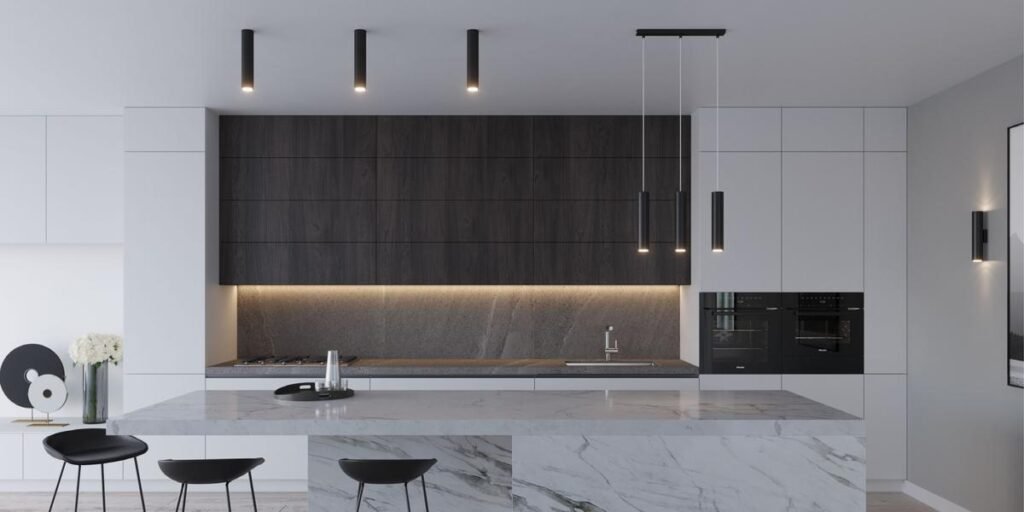
Whatever style your kitchen, we have light fixtures to suit view all Kitchen Island Lighting
What Height to Hang Kitchen Island Pendants?
Standard recommendation: 70-80cm above island worksurface (measured from shade bottom to countertop)
This height provides:
- Adequate task lighting without glare
- Comfortable sightlines across island (sitting or standing)
- Visual balance preventing fixtures appearing to “float”
- Safe clearance for taller users
Adjustments for specific situations:
Lower (65-70cm): Creates intimate atmosphere for islands primarily used for dining. Requires fixtures with upward-angled shades to prevent direct glare into eyes. Best for islands with seating on one side only.
Higher (75-85cm): Better for very tall users or islands in open-plan spaces where maintaining sightlines matters. Works when fixtures have strong downward focus directing light onto worksurface.
Installation tip: Use adjustable suspension cables or rods allowing height refinement after installation. Test heights before final fixing—what looks right on paper may need adjustment based on actual use patterns and sight lines.
Measuring correctly: Always measure from island worksurface (not floor) to bottom of shade (not top of fixture or suspension point). A 30cm tall pendant hung 75cm above counter has suspension point 105cm from worksurface.
Choosing the Right Pendant Size for Your Island
Pendant diameter dramatically affects visual impact and light distribution.
Small Pendants (20-28cm diameter)
Best for:
- Narrow islands (under 90cm wide)
- Creating delicate, repetitive patterns with 4-5 fixtures
- Kitchens with lower ceilings where smaller scale feels appropriate
- Grouping multiple fixtures for even light distribution
Advantages: Affordable to use multiple fixtures, creates rhythm and repetition, suits compact spaces
Limitations: Requires more fixtures for adequate lighting, can appear insignificant over wide islands
Recommended spacing: 50-60cm between fixture centres
Our small pendant collection includes compact industrial cages, mini glass globes, and contemporary ceramic designs from both Mullan and Sollux.
Medium Pendants (28-35cm diameter)
Best for:
- Standard islands (90-120cm wide)
- Most versatile size working across various kitchen styles
- Two or three fixture arrangements
- Balancing substantial presence with manageable scale
Advantages: Most universally appropriate size, wide style selection available, provides good light distribution without overwhelming
Limitations: May appear small over very wide islands, slightly less dramatic than large pendants
Recommended spacing: 60-70cm between fixture centres
Our medium pendant collection represents our largest selection, covering industrial, traditional brass, contemporary ceramic, and modern glass designs.
Large Pendants (35-45cm diameter)
Best for:
- Wide islands (120cm+ width)
- Making bold statements with single or paired fixtures
- High ceilings (2.7m+) where larger fixtures feel proportionate
- Dramatic focal points
Advantages: Strong visual impact, substantial light output, fewer fixtures required
Limitations: Requires higher ceilings, can overwhelm compact kitchens, more expensive per fixture
Recommended spacing: 70-80cm between fixture centres (if using multiples)
Our large pendant collection features statement industrial pieces, substantial brass designs from Mullan, and oversized contemporary fixtures from Sollux or even a Large Nautical Pendant!
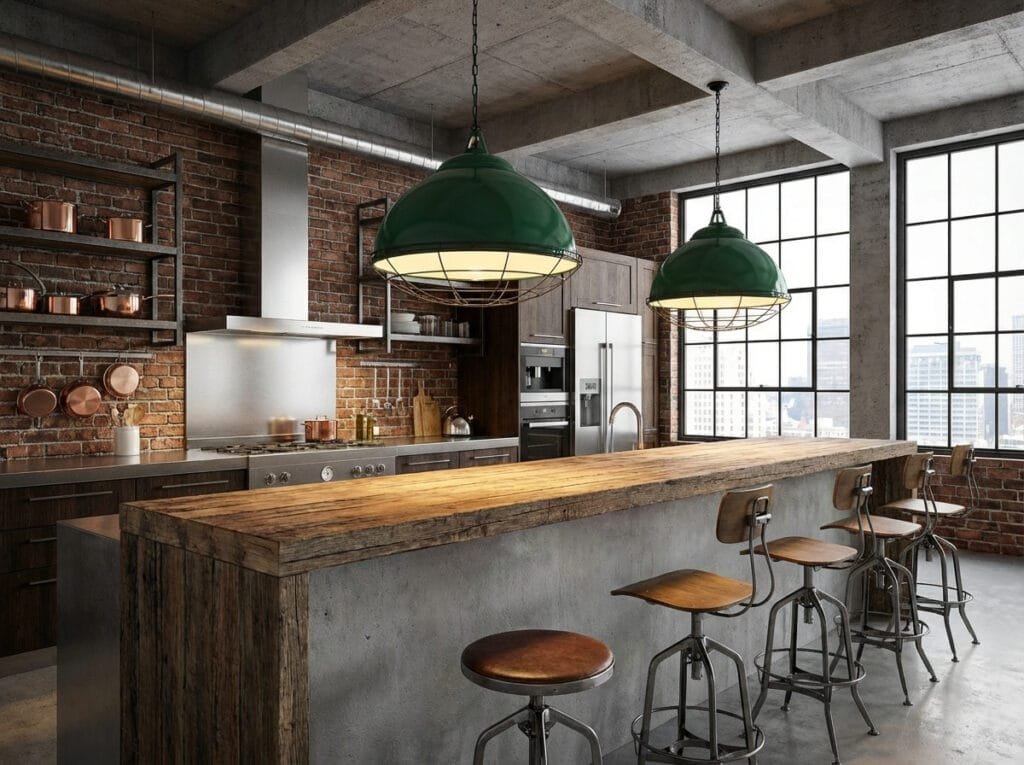
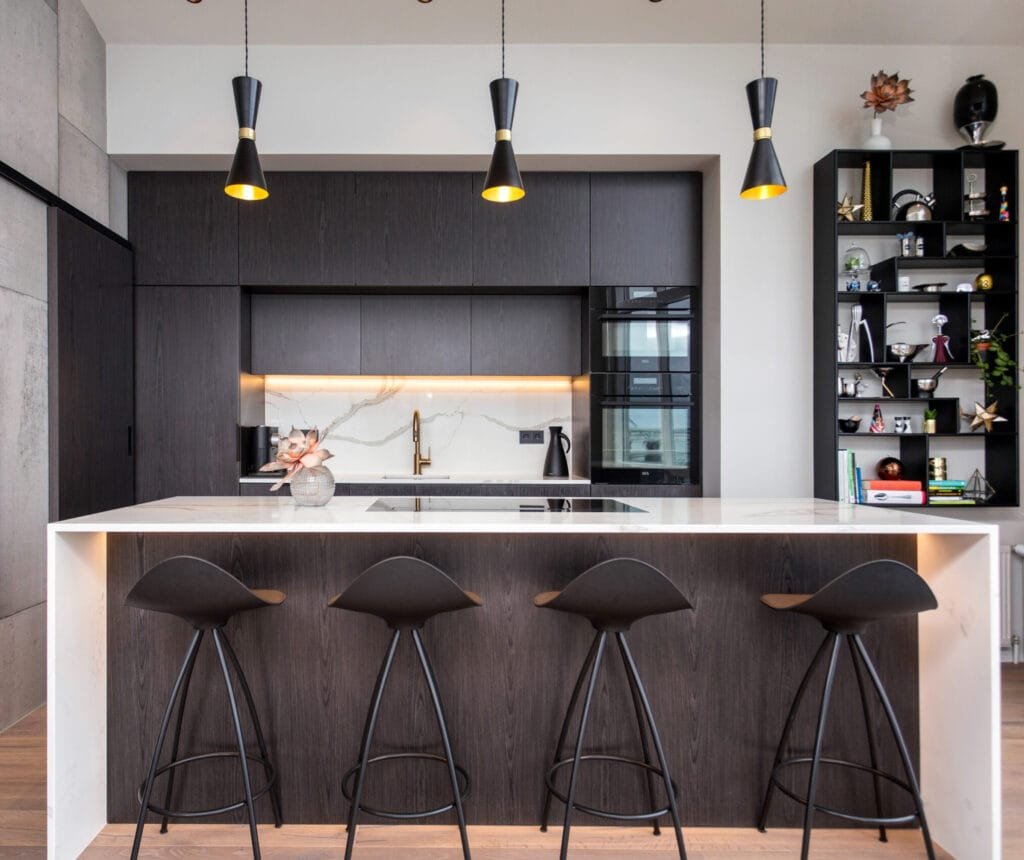
Kitchen Island Lighting Styles
Your island lighting should complement your kitchen’s overall aesthetic whilst reflecting personal taste.
Industrial Kitchen Island Lighting
Industrial pendants bring factory-inspired character combining raw materials, honest construction, and urban sophistication.
Characteristics:
- Exposed hardware and visible fixings
- Materials: aged brass, matte black powder coat, galvanised steel, copper
- Authentic details: cage guards, gooseneck arms, vintage switches
- Substantial presence and bold forms
Popular industrial options:
Dome pendants: Classic factory shapes in enamel or powder-coated metal. Wide shades direct light downward efficiently. Available in black, copper, brass, and vibrant colours.
Caged pendants: Metal cage surrounding Edison bulb creates shadow patterns and authentic factory aesthetic. Brass, black, or copper finishes. Dramatic when repeated along islands.
Exposed bulb fixtures: Celebrating bare bulbs and electrical components. Linear arrangements suit rectangular islands perfectly. Matte black frameworks provide graphic quality.
Our industrial island lighting collection features authentic designs from Mullan Lighting’s Irish workshops, emphasising quality metalwork and period-accurate detailing.
Styling tip: Pair industrial pendants with concrete countertops, stainless steel appliances, or exposed brick. Works beautifully in loft conversions, urban apartments, and modern farmhouse kitchens.
Traditional and Heritage Brass Island Lighting
Traditional pendants suit period properties, farmhouse kitchens, and spaces prioritising timeless elegance over contemporary trends.
Characteristics:
- Solid brass construction (never brass-plated zinc)
- Hand-finished in Ireland by Mullan Lighting
- Antique, aged, or polished finishes
- Period-appropriate detailing and proportions
Popular traditional options:
Schoolhouse globes: Timeless opal glass spheres with brass fittings. Clean lines suit traditional through contemporary kitchens.
Lantern pendants: Glass-panelled cage designs in brass or black. Traditional styling with practical light distribution.
Victorian-inspired: Ornate brass fittings with etched or ribbed glass shades. Suitable for heritage properties requiring historically appropriate lighting.
Our traditional island lighting emphasises Irish craftsmanship and quality materials designed to last generations rather than years.
Styling tip: Traditional brass pendants complement shaker cabinets, marble countertops, and farmhouse sinks. Works across period properties and new-builds seeking timeless appeal.
Contemporary and Modern Island Lighting
Contemporary pendants suit minimalist kitchens, Scandinavian-inspired spaces, and modern properties prioritising clean lines.
Characteristics:
- Simple geometric forms
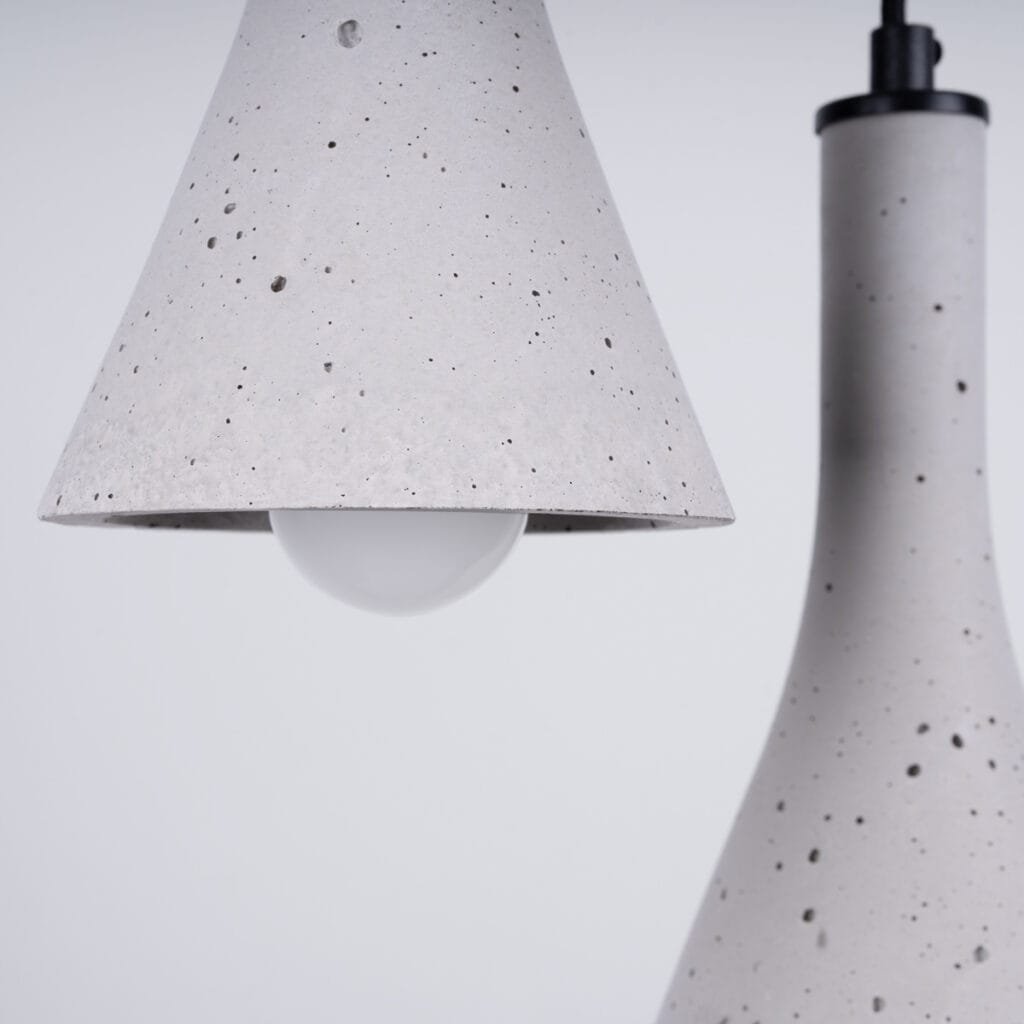
- Materials: ceramics, glass, concrete, brushed metals
- Minimal ornamentation
- Focus on form and materiality
Popular contemporary options:
Ceramic pendants: Hand-glazed designs from Sollux (Poland) featuring unique reactive finishes. Each piece slightly different due to artisan glazing processes.
Concrete pendants: Raw concrete or concrete-effect finishes providing industrial edge with modern refinement.
Glass pendants: Clean-lined transparent or opal glass in simple forms. Modern interpretation of classic globe designs.
Our contemporary island lighting features Sollux designs from Poland, emphasising Scandinavian-influenced aesthetics and quality European manufacture.
Styling tip: Contemporary pendants complement handleless cabinetry, minimal hardware, stone or Corian countertops, and integrated appliances.
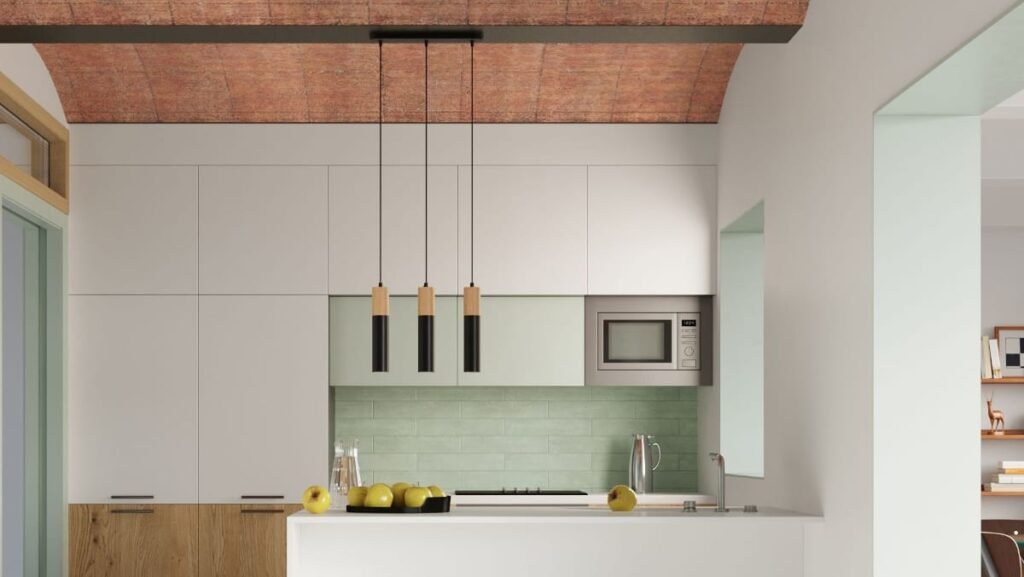
Technical Specifications: Getting the Details Right
Lumens and Light Output
Kitchen islands require substantial illumination for safe food preparation.
Recommended lumens per pendant:
- Task-focused islands (primary prep surface): 800-1,200 lumens per fixture
- Mixed-use islands (prep + dining): 600-900 lumens per fixture
- Dining-focused islands: 400-600 lumens per fixture
Example calculation:
- Island dimensions: 2.4m × 1.2m = 2.88 square metres
- Target illumination: 400 lumens/m² × 2.88m² = 1,152 total lumens
- Three pendants: 1,152 ÷ 3 = 384 lumens per pendant minimum
- For task lighting: aim for 600-800 lumens per pendant
Colour Temperature Selection
3000K (Soft White): The sweet spot for most kitchen islands. Warm enough for inviting atmosphere, clear enough for accurate food preparation. Works with any style.
2700K (Warm White): Traditional, cosy atmosphere. Flattering for skin tones during dining. Can make food preparation slightly challenging due to yellow cast.
3500-4000K (Neutral White): Crisp, clean illumination. Excellent colour rendering for food preparation. Can feel slightly clinical if used exclusively.
Recommendation: 3000K provides ideal balance for most homes.
Bulb Selection
LED bulbs: Always choose LED for efficiency, longevity, and quality light output.
LED Filament: Exposed bulb fixtures benefit from decorative filament bulbs providing vintage appearance with modern efficiency.
Dimmable LED: Essential for island lighting. Verify bulb compatibility with dimmer type.
Installation and Electrical Planning
Working with Electricians
UK regulations: Part P Building Regulations require electrical work by registered competent persons or Building Control notification.
Professional installation ensures:
- Correct circuit sizing and protection
- Safe installation of heavy fixtures
- Proper positioning and mounting
- Code compliance and valid warranties
Common Mistakes and How to Avoid Them
Mistake 1: Insufficient Fixture Quantity Single pendant over long island creates uneven lighting. Solution: Calculate appropriate fixture quantity based on island length.
Mistake 2: Incorrect Hanging Heights Pendants hung too low obstruct sightlines. Solution: Follow 70-80cm guideline measured from worksurface to shade bottom.
Mistake 3: Forgetting Dimmer Switches Fixed brightness creates harsh atmosphere during dining. Solution: Always install dimmers for flexibility.
Conclusion: Creating Your Perfect Island Lighting
Successful kitchen island lighting balances functionality, aesthetics, proportion, and quality. By understanding how many fixtures you need, hanging them at appropriate heights, selecting sizes matching your island configuration, and investing in quality European-crafted fixtures, you create island lighting serving daily needs reliably whilst enhancing your kitchen’s visual appeal.
Browse our complete kitchen island lighting collection featuring:
- Industrial pendants – factory-inspired designs from Mullan Lighting
- Traditional brass pendants – solid brass handcrafted in Ireland
- Contemporary ceramics – hand-glazed designs from Sollux Poland
- Modern glass and concrete – Scandinavian-influenced minimalism
All fixtures accommodate modern LED bulbs, include proper UK certifications, and feature quality construction from established Irish and Polish manufacturers.
For the full range of kitchen lighting ideas including pendant and wall options beyond island lighting, visit our Kitchen Lighting category — covering brass, glass, ceramic, and modern styles suitable for over islands, dining areas, and breakfast bars.